
- Shop Shop
-
Desktop
Desktop
FDM / FGF

High speed GP1

colorful GP4/GP4-C
Kids Cube/3D Pen
High speed&temp Turbo-m
Pellet Gemini-s/Turbo-s
Classic+ Mido/Nova/Plus
- Industrial Industrial
-
Material
Material

Resin series

Dental DM100/TC100/ etc.

Jewelry Jewelry Resin

Generic PW100

Industry High Temp Resin

Garage Kit Red wax
-
Expanded
Expanded
Laser/CNC/3D scanner

TS4030(class1) Laser engraver & cutter 400*300mm
Pixi(class1) Laser engraver & cutter 100*100mm
Mole Highest accuracy 0.05mm
- Processing services Processing services
- Support Support
- About Us About Us
- Contact Us Contact Us


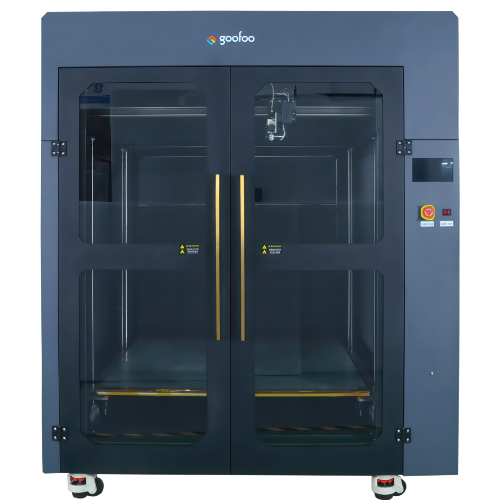















3D Printing for Automotive
Shape the future of auto innovation with Goofoo additive technology solutions for product development, production support, and end-use parts.
With the continuous development of social economy and the improvement of people's living standard, automobile has become one of the indispensable means of transportation in people's daily life. Traditional automobile production mode due to the fixed production line, large production batch, long cycle and other characteristics, there is a failure to meet the individualized demand, waste of resources and other issues. With the increasing diversification and personalization of consumer demand, automobile customized production has become an inevitable trend in the development of the automobile industry. In this context, 3D printing technology, as a new type of manufacturing technology, has gradually attracted the attention of the automotive manufacturing industry with its advantages of speed, flexibility and personalization.
Automotive Parts
3D printing technology has a wide range of applications in automotive parts manufacturing. Automotive engine parts, seat accessories, lamp housings, etc. can be customized production through 3D printing technology. Compared with the traditional injection molding or casting process, 3D printing technology can significantly shorten the design and production cycle of parts and components, reduce production costs, and can realize the manufacture of complex structures, improve the performance and quality of parts.
1, 3D printing in the application of automotive components
3D printing applied to automotive parts research and development process can quickly verify the working principle and feasibility of complex parts, eliminating the process of mold development, but also reduce the time and capital investment. At the same time, as people's demand for automotive lightweight, personalization, intelligence continues to rise, due to the limitations of the traditional manufacturing process, the emergence of 3D printing technology can effectively meet these needs.
3D printing technology in automotive parts manufacturing applications mainly include: (1) the manufacture of structurally complex parts (2) multi-material composite parts, 3D printing technology can be multi-material, multi-color molding, to achieve the different parts of the parts of the different material properties and color requirements (3) 3D printing can be optimal for the structure of the parts designed to achieve a lightweight structure of the parts (4) personalized custom parts Parts (5) small batch parts (6) emergency parts
2, 3D printing in automotive parts mold application
The increasingly fierce competition in the automotive industry requires the rapid upgrading of automotive parts, 3D printing technology began to be used in automotive parts molds, in order to improve the mold manufacturing process exists in the operation of complex, high cost, time-consuming and other issues. The use of 3D printing technology, not only can shorten the development cycle of auto parts molds, but also able to manufacture complex structures of precision molds.
3, distributed production
The automotive industry is a highly centralized industry, a large number of parts and components are shipped to the factory, assembled into a complete vehicle on the production line. And then shipped to all parts of the world for sale. As a result, it is necessary to use a large amount of transportation capacity. And 3D printing can realize distributed production, in the local 3D printing chassis, various parts, and then assembled.
4, print the whole car
Although there is still a certain distance from mass production, but over the years, there have been a lot of various 3D printed cars and electric cars. The current 3D printing technology can already be used to print the entire car chassis, frame, doors, etc., and 3D printing of the chassis and other parts can be integrated with multiple parts, one print out, not only to reduce the assembly time, but also to enhance the firmness.
3D Printed Extra Supercar Czinger
Source: Divergent Technologies
The Decentralized Adaptive Production System (DAPS) developed by Divergent Technologies has become a highly effective “digital automotive factory” used to build the 1,250 hp 21C sports car, which not only features a 3D printed manufacturing process, but is also loaded with 3D printed critical components. Key components.
For example, the Inconel exhaust system and windshield, printed on SLM Solutions equipment, are strong and complete enough to withstand extremely high speeds. Suspension rockers, crash structures, instrument panels and exhaust silencer drums were printed in Inconel, aluminum and titanium alloys.The 3D printed gearbox housing enables the heat exchanger to become part of the housing structure, rather than hanging off the outside of the gearbox, which not only saves space, but also helps to improve the efficiency of the heat exchange.

BMW's “Industrialization and Digitalization of Additive Manufacturing” project
Source: BMW
BMW Motorrad's IDAM Automotive Additive Manufacturing Industrialization and Digitization Project, which was launched in 2019 and took three years to complete, has been announced by BMW.
The IDAM project aimed to pave the way for additive manufacturing to enter automotive series production, driving the “industrialization and digitization of additive manufacturing (AM) technologies in the automotive sector.” The project established two production lines, one at GKN's Bonn plant and the other at the BMW Group's Munich plant, which reduced manual activity from 35% to 5% through automation, and more than halved the cost of 3D printed metal parts.
For 30 years, BMW has continued to pursue industrialized 3D printing and has applied it to different models, including 3D printed brake calipers for the M850i Night Sky Special Edition and 3D printed parts for the BMW 6-cylinder engine S58.

BMW Develops 3D Printed Brake Calipers for M850i Night Sky Special Edition

3D printed parts for engine S58
3D Printed Car Interiors
Source: Peugeot
French automotive brand Peugeot is known for its unique and well-made cars. Peugeot's new 308 model is an upgraded version of the brand's 3008 SUV, and the team of designers has given the new generation a smaller, sportier look.
It's no surprise that the new 308 models come with storage bins and integrated assistance features. Starting with a new flexible polymer, Peugeot used innovative 3D printing technology to create sunglass holders, cup holders and cell phone/card holders to fit the 308's center console.

Ferrari 3D printed brake pedal
Source: Ferrari
3D printing can design lighter, stronger and more efficient parts in less time. Ferrari relied on this technology (specifically metal 3D printing) to design the pistons for one of its engines. The manufacturer also designed 3D-printed brake pedals with hollow structures - a result not possible with other manufacturing methods.
Michelin 3D Printed Uptis Tires
Source: Michelin
French tire manufacturer Michelin has unveiled its first prototype tire powered by additive manufacturing technology. Called Uptis (Unique Puncture Resistant Tire System), the tire is designed to be airless to reduce the risk of tire leaks and other air leak failures due to tire punctures or road hazards. The company developed this 3D printed prototype in collaboration with General Motors. So far, 3D printing technology has only been used to develop prototypes using renewable and biomaterials, but if production reaches larger quantities, the technology could be used on a larger scale. These puncture-proof tires could also reduce waste and promote sustainable mobility (one of the goals of the company's vision for the future of mobility).

MINI Customized Car Parts
Source: MINI
MINI offers some customization for its cars with additive manufacturing technology. Since 3D printing offers greater design freedom, it is possible to reduce lead times and increase the complexity of parts at an affordable cost. As a result, MINI customers have the opportunity to customize their cars by designing their own cockpit passenger side straps and side inserts.

3D printed windshield wipers
Source: local motors
Arizona-based automotive OEM Local Motors has announced a series of new upgrades to components for its 3D-printed self-driving electric car, the Olli 2.0. After a successful rollout in the U.S., Local Motors found that it needed to fit a set of windshield wipers due to stricter EU regulations. To manufacture the critical components, the company's EMEA management sought the help of CRP Technology, an Italian 3D printing service provider. Utilizing CRP's proprietary Windform composite material, the companies have now designed, 3D printed and integrated a number of additional windshield wiper upgrades to support the approved European project.

 Esperanto
 Shqiptare
 Euskara
 Zulu
Zulu
 Latinus
 Cymraeg
 தமிழ்
தமிழ்
 Slovak
 Slovak
 Afrikaans
Join us
Subscribe to get the latest news


Skype / WhatsApp: +86 592-5713513 / +86-13860126490
No.88-3, North Tongji Road, Xike County, Tong'an District, Xiamen, Fujian China
Xiamen Goofoo Technology Co., Ltd. All Rights Reserved 闽ICP备2022008070号-1 SEO 300.cn
Phone:+0086 592-5713513
Address: No.88-3, North Tongji Road, Xike County, Tong’an District, Xiamen, Fujian China
Email: sales@goofoo3d.com
We will give you feedback in time